
Timber farmhouse in Sesto, South Tyrol. Contemporary renovation projects in this valley have used Strickbau panel elements as direct replacements for masonry external walls. Wikimedia Commons, CC licence.
The term Strickbau refers to a family of horizontal log construction methods in which squared or rectangular cross-section timbers are stacked and notched at the corners, forming a monolithic structural wall panel. The distinction from Blockbau, though the two terms are sometimes used interchangeably in popular literature, typically lies in the cross-section geometry: Strickbau elements are more commonly rectangular in section, permitting thinner wall assemblies and factory prefabrication.
Interest in Strickbau among architects and developers in the Italian Alpine provinces has grown since the early 2010s, driven by a combination of carbon accounting requirements in building permits, rising masonry labour costs, and a demonstrable market preference for natural materials in the short-term holiday accommodation sector of the Dolomites and Alto Adige.
Why Strickbau Returned
The immediate catalyst in the South Tyrol context was the introduction of mandatory lifecycle carbon assessment for new residential construction over 300 m² as part of the provincial CasaClima energy standard, administered by the Agenzia CasaClima. Solid timber wall systems — both cross-laminated timber (CLT) and Strickbau — achieve better lifecycle scores than lightweight timber-frame systems insulated with mineral wool because of the large mass of biogenic carbon sequestered in the structural timber itself.
For a typical 180 mm Strickbau wall using locally sourced spruce or larch at 450–590 kg/m³, the sequestered biogenic carbon content is approximately 100–130 kg CO₂-equivalent per square metre of wall. This figure, calculated under EN 16449 methodology, frequently offsets the operational energy carbon of a well-insulated Alpine building over a 50-year assessment period.
Adapting Historic Notch Geometry to Modern Loads
The primary structural challenge in contemporary Strickbau is not the corner joint itself — historic proportions work well at residential scale — but the opening geometry. Historic Blockbau and Strickbau buildings had narrow, deeply framed openings because the log wall needed continuous bearing area. Contemporary clients expect large glazed facades, particularly on south-facing Alpine elevations.
The engineering response has been to treat the Strickbau panel as a shear wall module interspersed with CLT or glulam portal frame elements at opening positions. The Strickbau panel carries vertical gravity load and horizontal racking load continuously; the frame element spanning the opening transfers the concentrated load of the log stack above it into the adjacent panel. This hybrid approach has been documented in several completed buildings in the Val Gardena and reviewed in the proceedings of the World Conference on Timber Engineering.
Settlement Allowance in Contemporary Design
The vertical settlement of a Strickbau wall — between 1 and 2.5 percent of wall height during the first two years — remains a live engineering problem in contemporary practice. Factory-dried timber at 12–15 percent moisture content reduces but does not eliminate settlement. Window frames, door frames, and any rigid connections to concrete or steel elements must accommodate this movement.
Contemporary practice in South Tyrol typically uses slotted connection brackets at floor-to-wall interfaces, identical in principle to the compression posts used in historic structures. The slot dimension is sized using the vertical compression model described in the German standard DIN 68365 as adapted in the timber engineering guidelines of the Holzforschung Austria research institute.
Thermal Performance and Contemporary Code Requirements
A plain Strickbau wall — 200 mm of solid spruce with no additional insulation — achieves a U-value of approximately 0.35 W/(m²·K). The CasaClima Gold standard for new residential buildings in South Tyrol requires a maximum envelope U-value of 0.15 W/(m²·K), which a solid timber wall cannot achieve without supplementary insulation. The practical response is to add a ventilated external cladding layer over a mineral wool or wood-fibre board insulation layer applied to the exterior face of the Strickbau panel.
This approach preserves the thermal mass and interior hygrothermal buffering of the solid timber wall — benefits not captured by the steady-state U-value calculation — while meeting the code requirement through the additional insulation. The wood-fibre board option is preferred in the provincial conservation guidance because it is vapour-open and allows the Strickbau timber to continue exchanging moisture with the external climate, maintaining the drying capacity that prevents long-term moisture accumulation in the log cross-section.
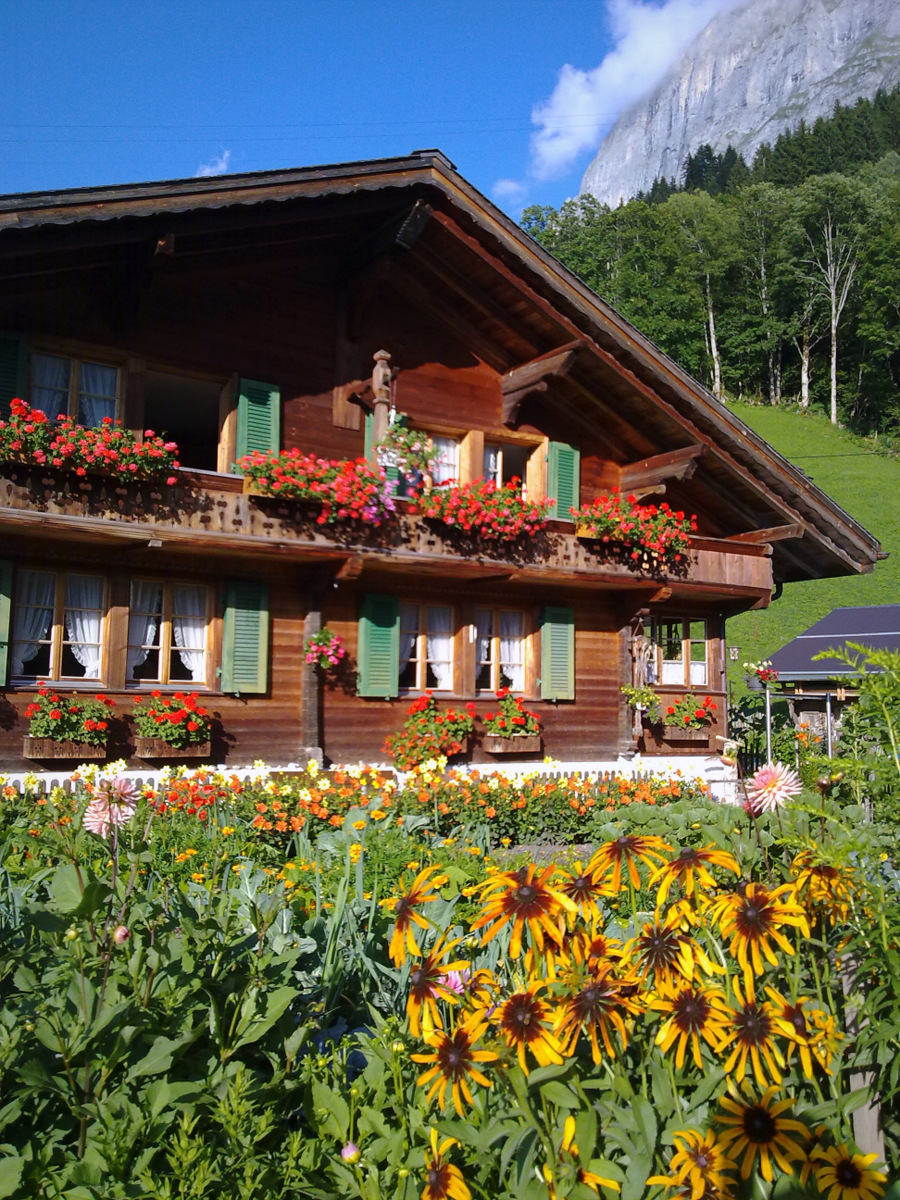
Swiss Alpine timber construction — a regional variant of the same Strickbau tradition practiced across the Alps. Wikimedia Commons, CC licence.
Fire Resistance in Solid Log Walls
Italian fire code — Decreto Ministeriale 16 febbraio 2007 and its successor documents — classifies building elements by fire resistance duration (R, E, I ratings). Solid timber performs better in fire than its combustibility suggests: a 200 mm solid spruce wall achieves approximately R 60 (60 minutes structural integrity under standard fire) due to the char layer that forms on the surface and insulates the interior.
For buildings requiring R 90 or higher, engineers in the Italian Alpine context have addressed this either by increasing log cross-section to 240–260 mm or by applying an additional layer of gypsum board on the interior face. The gypsum option is controversial in heritage-adjacent contexts because it covers the visible timber interior that is part of the architectural character of the building type.
Case Distribution: Where Contemporary Strickbau Appears
Documented contemporary Strickbau and hybrid log-frame buildings in the Italian Alpine provinces are concentrated in three zones:
- Val Gardena and surroundings: Tourism-driven hospitality construction where natural material character is a marketing element and procurement networks for certified Alpine timber are well established.
- Puster Valley (Val Pusteria): Agricultural and rural residential reconstruction, often supported by provincial rural development funding that preferentially subsidises traditional construction methods.
- Trentino western valleys: Smaller-scale residential and secondary-structure work, typically below 500 m² total floor area, where individual craftspeople rather than large contractors carry the construction.